How to Prepare a WordPress Site for Google’s Generative AI Search
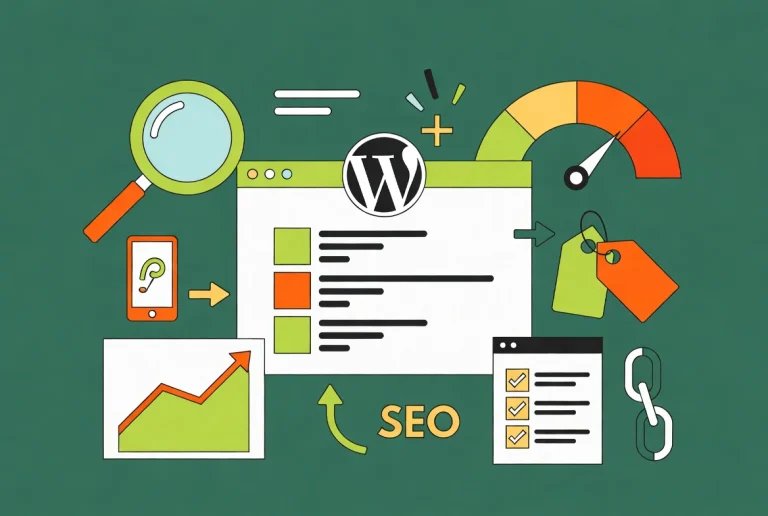
Google’s generative AI search does not require a secret “GEO” trick. A WordPress site still needs crawlable pages, helpful original information, a clear structure, and a good experience. This practical checklist shows what to fix before you measure visibility in AI Overviews or AI Mode.

What Google actually requires
Google says the same technical requirements apply: a page must be indexed and eligible to appear with a snippet in ordinary search. There are no additional technical requirements or special markup that guarantees an AI feature placement. Inclusion is never guaranteed, so use Search Console to find crawl, indexing, and performance problems.
1. Make every important page crawlable.
- Confirm WordPress is not blocking search engines in Settings → Reading.
- Submit one canonical XML sitemap and check representative URLs with URL Inspection.
- Remove accidental noindex tags, broken canonicals, redirect chains, and orphan pages.
- Keep key text in the HTML DOM; do not hide essential answers behind clicks or blocked JavaScript.
2. Add information gain, not generic summaries.
AI systems have plenty of interchangeable summaries. Give readers something that changes a decision: screenshots from your workflow, a dated test method, setup steps, limitations, pricing context, before-and-after results, or a comparison table with clear criteria. Separate documented vendor claims from what you personally verified.
3. Structure articles so people and machines can follow them.
- Answer the main question in the opening paragraph.
- Use descriptive H2 and H3 headings that match real sub-questions.
- Keep one idea per paragraph and define technical terms on first use.
- Add tables, numbered procedures, and concise checklists where they improve decisions.
- Link to related CreatePressHub guides with descriptive anchor text.
4. Strengthen trust signals
Show who wrote and reviewed the article, when it was updated, how products were tested, and which primary sources support important claims. Keep an editorial policy and disclose affiliate relationships. If AI helped with drafting, editing, fact-checking, and adding original analysis, publishing large volumes of low-effort pages can violate Google’s scaled-content-abuse policy.
5. Improve the page experience
Use a responsive Kadence layout, readable type, stable image dimensions, descriptive alt text, and restrained scripts. Test real mobile devices, Core Web Vitals, keyboard navigation, and intrusive pop-ups. A fast, accessible page helps users who arrive from both classic results and AI features.
6. Measure visibility without chasing a new metric
AI-feature traffic is included in Search Console’s overall web performance data. Compare clicks, impressions, CTR, queries, landing pages, and conversions before and after meaningful updates. Annotate your spreadsheet with the date, page changes, and source updates so you do not mistake normal query demand for an algorithm effect.
WordPress implementation checklist
- Audit sitemaps, canonical tags, and internal links in Search Console.
- Choose ten priority articles and add a clear answer, original evidence, and limitations to each.
- Standardize author, published, and last-updated metadata; keep dates truthful.
- Compress and caption images, then assess mobile layout and loading performance.
- Review schema for accuracy and validate it; never mark up content that is not visible on the page.
- Track clicks and conversions for 28 days, then improve the pages that attract many impressions but few clicks.
Frequently asked questions
Do I need special AI schema?
No. Google’s guidance says there are no additional technical requirements for AI Overviews or AI Mode beyond normal search eligibility.
Can AI-written WordPress posts rank?
Use AI as a research or drafting aid, then add accuracy checks, first-hand context, and meaningful editorial work. The standard is helpfulness and originality, not the tool used to create the first draft.
Primary sources
- Google’s guide to optimizing for generative AI features
- AI features and your website
- Google’s guidance on generative AI content
- Creating helpful, reliable, people-first content
Editorial note: recommendations above follow Google’s published guidance. Search appearance and traffic are not guaranteed; validate changes with your own Search Console and Analytics data.